Showing posts with label Advice. Show all posts

4/14/2013

My Gear

When I started hiking, I didn’t set a high value on my equipment. I just put on old leather boots or sneakers and went outdoors. Once, I climbed Hochlantsch (Austria, 1721m) wearing shorts and trainers and surprisingly my socks didn’t get wet, but I caught a cold and so on… This story made me realize that gear is very important and there are situations when you can’t dispense with proper clothing or tools.

Footwear: 
When buying new hiking boots, make sure you select a waterproof one! If your boots get soaked, the remaining part of your hike can be terrible. Consequently, wearing improper footwear doesn’t allow you to enjoy your hike, since you always need to pay attention to each and every of your steps. Hiking is about experiencing nature around you. Why would you spoil this by having low-quality shoes? 

Currently, I wear Quechua Forclaz 600 when I’m hiking. (Click on the link for technical details and excellent photos of the boot). It’s absolutely waterproof, comfortable, made of high-quality materials, and ideal for all-day hikes. 


Gaiters: 
At first I didn’t know why to wear these. The reason is simple: they protect your shin from wetness, mud, and sharp underwood. Good gaiters make hiking comfortable even in knee-high snow or on extremely muddy trails. What is more, it prevents your trousers from getting dirty and soaked. I possess a Tatonka Gaiter 420 HD

Without gaiters you'll be this dirty!

Raincoat: 
You can never trust weather forecast; therefore, always take a reliable raincoat with you. No doubt, a well-ventilated rain jacket is essential. Airing is important: a good mackintosh protects you from rain, but lets your sweat out, so you won’t be streaming with perspiration. Unfortunately, I don’t have a really good one yet, but I plan to buy one soon. 

I think these are the most important parts of one’s gear when going to one day hikes. Of course, you can have special trousers, socks, and rucksack but these are not essential. Personally, I use old military training trousers and a worn-out backpack. I’ve never encountered problems with these, they are quite okay.  Spring has arrived!!! I hope I can write a hike report to you next week. Stay tuned! 

4/04/2013

Before You Go...


Because of all the tasks I need to do, I can’t go for a hike this weekend. What’s more, the weather is still gloomy and rainy; floods and inland inundation would make hiking unpalatable. Some roads are covered with snow and ice and water level of rivers is still rising because of last week’s rainfalls. I am also feeling under the weather a bit. Is this something worth complaining about? Certainly not! 

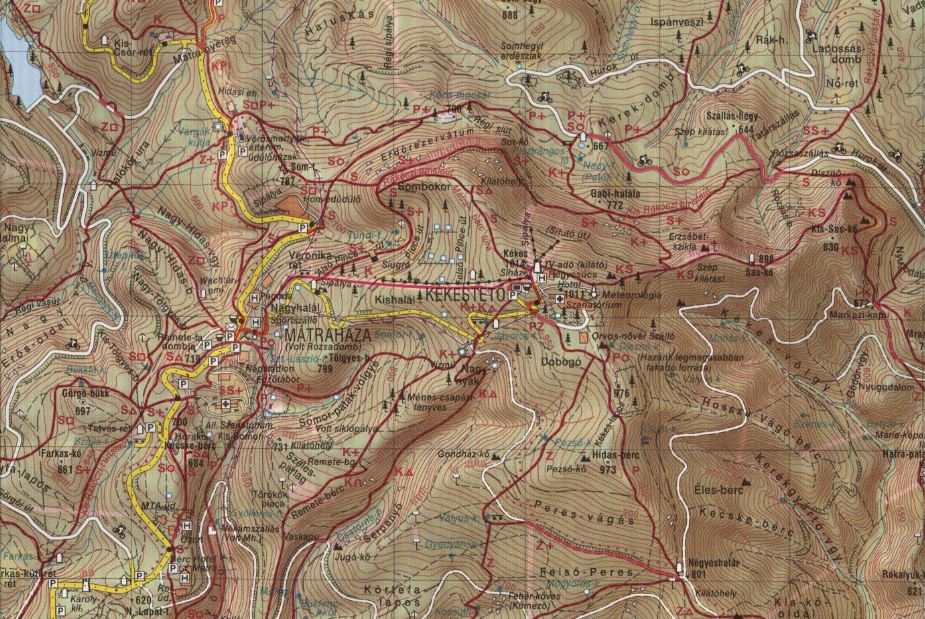
If you can’t go for a hike, do some planning for the next one! That’s what I was doing when I decided to write this post. I have never been to Kékestető, the highest peak of Hungary (1014m), and I really eager to visit this place. After visiting Bakony I would rather hike in Mátra, Kékestető belongs to this mountain range. As I was looking for hiking trails I found some handy websites which are in English, so you can read them and make your planning much easier.

Map of Kékestető
Click here for information about sights, activities, and accommodation in Mátra!

Another place you may want to visit is Rám-szakadék. It is similar to Holdvilág-trench, but this gorge is longer, deeper, and more spectacular. Travel to Dömös and start the hike to Rám-szakadék there. Don’t try to go through it when the weather is rainy or it is snowing. Always follow the path there and don’t try to climb out of the ravine because it’s life-threatening. Only do the hike from Dömös up to Dobogókő and not the opposite way. (Otherwise, “traffic jams” will occur in the gorge).

Just one more place to mention: Balaton Uplands (Hun: Balaton Felvidék). Spectacular!!! I’ve been there last fall, but the weather was so foggy that I can’t even make a satisfying photo…   


If I have the time and the weather is better than now, I will definitely visit these places and shoot photos near Lake Balaton again.


2/23/2013

Signs, Rules, Advices

Last weekend I was hiking in Buda-hills. It was the first organized performance trip I took part in and I’ll post about it next week. Not now, because I feel that I need to share some essential information you definitely need to know before you go to a Hungarian hike. The hiking signs, fire lighting regulations, and rules governing camping in the forest are different in various countries. If you don’t know how to interpret the signs, you can easily get lost; moreover, anyone who violates the rules may be punished. For these reasons, I strongly recommend that you read the following concise post. 

Hiking signs in Hungary are quite easy to remember and understand. These are painted on a 100 X 120 mm white background, using four colors (blue, red, yellow and green). In maps, trails are not indicated with these colors, but you can find capital letters next to them: K, P, S, Z; these are the initials of Hungarian words referring to the color of the particular route. The main and most important trails are indicated with horizontal line or cross . A triangle  is used to show a trail leading to a peak, hilltop, or lookout turret. If you would like to reach a populated area or a shelter house, you need to follow the square . Care for some fresh spring water? Look for the circle,  it leads to a place where you can find potable water! You can also find some special signs indicating caves and ruins

Light a fire only if it is permitted in the area you are hiking in. Check this website for information: Click here! (Red means forbidden). If it is allowed, find a built forest “fireplace” or simply form a circle with rocks and light a fire there. Make sure that you extinguished the fire properly before you continue your trip. Pour some water on the ember and cover it with sufficient amount of soil. Remember that even one little spark can cause a huge disaster. 

Finally some words about camping in the wild. Lots of people think that in Hungary it is completely forbidden to set up a tent in the woods and spend a night there. Actually it is not. Obviously, highly protected national parks are exceptions. If you contact a member of a local forestry and want to spend only one night in a particular area, than you may do so. Try to cause minimum harm to nature: Do not litter, do not break branches unnecessarily, and do not throw away your cigarette stub. 

Leave your camping place as if you had not been there. An example of a special hiking sign in Sopron-parkforest. It indicates the "cyclamen-trail". I shot the photo above this morning

2/18/2013

Here We Go!

Most of the people from abroad and even Hungarians may think that Hungary is not an ideal place for hiking. There are no dizzyingly high mountains, (the highest point is called Kékestető, “only” 1,014 meters above sea level) deep canyons, and dangerous volcanos. Although, we do not have these features, Hungary has several spectacular places for everyone who loves being outdoors. The monadnocks of Balaton Highlands, (Hun: Balaton-felvidék) the Danube Bend (Hun: Dunakanyar), and the Hortobágy, which is the largest natural grassland in Europe, are only some of the wonders of this small but beautiful country.

I have been hiking for years now and I also participated in canoe and cycling trips in Hungary and on abroad as well. Originally, I was required to create a blog as an academic task. I reckon it is really hard to find a good blog topic which is not hackneyed; it is even harder to write engaging posts about it weekly. I realized that outdoor activities are parts of my life, so I decided to create this blog and share my hiking experiences with everyone who would like to hike here and feel the unique atmosphere of Hungarian landscape.  

For the first time, I was hiking near my hometown at Sopron-mountains, (Hun: Soproni-hegység, Ger: Ödenburger-Gebirge) close to the "Foot of the Alps" and I became attached to this activity and nature there. Some of my posts will focus on the hiking opportunities in that particular area. Now I am studying in Budapest; therefore, I can easily go for a trip to Buda-hills (Hun: Budai-hegység) or Pilis Mountains (Hun: Pilis hegység). I am a rather spontaneous person, so I do not do thorough planning before hiking; I just find a destination, take a relevant map, put on my boots and start off. Of course, in this blog I will provide the readers with every piece of necessary information about the hike and the essential gear which must be used.  

And finally, I would like to recommend a useful book: (If you happen to be a Hungarian reader you are lucky). Balázs Nagy, Trekkingtúrázás Magyarországi túraútvonalak. Budapest: CSER, 2011. I find this book really advantageous. It contains not only illustrated descriptions of Hungarian hiking trails, but it serves with some general advices about hiking. Fortunately, the structure of the book is so clear that you can easily deduce the most important pieces of information, (destination, length, elevation) even if you are a non-Hungarian person.  

Thank you for reading this, next week it is going to be more exciting! See you!